How Businesses Can Mandate A-I-R-S™ for Vendors, Clients, Employees, Contractors and Students
How Businesses Can Mandate A-I-R-S™ for Vendors, Clients, Employees, Contractors and Students
Business A-I-R-S™ for Third-Party Verification and Individual A-I-R-S™ for Workforce, Contractor and Student Verification
How Businesses Can Mandate A-I-R-S™ for Vendors, Clients, Employees, Contractors and Students
Modern businesses increasingly operate through networks of vendors, clients, suppliers, employees, contractors, consultants, interns and students. Every external relationship can introduce a new verification, compliance and business-trust requirement.
Traditional verification processes often focus on collecting documents, checking information manually and maintaining records across different systems. As business ecosystems become more interconnected, organizations need a structured way to establish and maintain trust across both business entities and individuals.
This is where A-I-R-S™ — American Industry Rating Standard can be positioned as a business and individual verification framework.
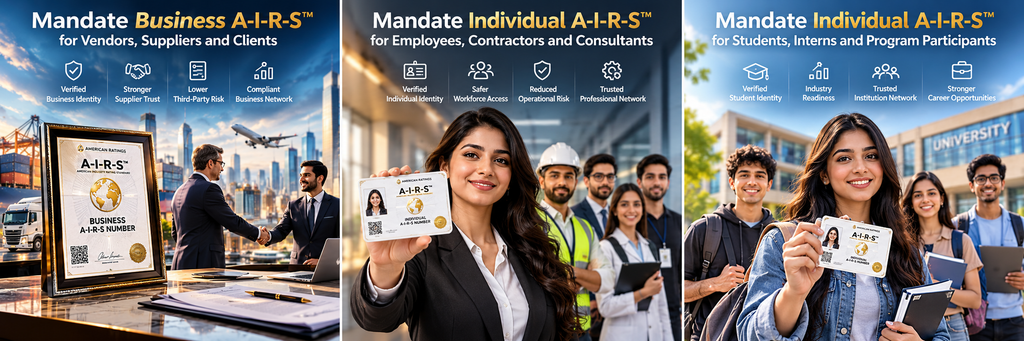
Organizations can establish an internal or external A-I-R-S™ mandate, requiring the relevant parties within their ecosystem to obtain the appropriate A-I-R-S™ identification and certification.
The model can be divided into two primary categories:
- Business A-I-R-S™ — for vendors, suppliers, clients, distributors, partners and other business entities.
- Individual A-I-R-S™ — for employees, contractors, consultants, students, interns and other individuals working with or participating in an organization.
This creates a structured approach to business verification, third-party risk management, workforce verification and business trust.
What Is an A-I-R-S™ Mandate?
An A-I-R-S™ mandate is a business requirement established by an organization asking a defined category of businesses or individuals to obtain A-I-R-S™ certification or identification as part of its relationship, onboarding, compliance or verification process.
For example, a company may establish a policy stating:
All vendors and suppliers working with the organization must maintain a valid Business A-I-R-S™.
Similarly, an organization may establish:
Employees, contractors and consultants working with the organization must maintain a valid Individual A-I-R-S™.
A university, training organization or educational institution could also establish an Individual A-I-R-S™ requirement for students participating in specific programs, internships, industry projects or employment-linked initiatives.
The objective is to create a consistent verification requirement instead of relying entirely on different verification procedures for every relationship.
1. Mandate Business A-I-R-S™ for Vendors and Suppliers
Vendors and suppliers are an essential part of almost every business.
A company may work with manufacturers, technology providers, logistics companies, consultants, agencies, distributors, service providers and other third parties.
Each relationship can involve different levels of commercial and operational risk.
A Business A-I-R-S™ mandate can therefore be incorporated into a company’s vendor onboarding or third-party management process.
For example:
Vendor onboarding requirement:
- Vendor submits business information.
- Organization initiates its vendor verification process.
- Vendor obtains or provides Business A-I-R-S™.
- Business information is associated with the A-I-R-S™ identification.
- Vendor proceeds through the organization’s applicable onboarding and compliance process.
This can provide organizations with a standardized business identity reference that can be incorporated into their internal processes.
2. Mandate Business A-I-R-S™ for Clients
A-I-R-S™ mandates do not have to be limited to suppliers.
Businesses can also establish requirements for clients, customers, distributors, channel partners and other commercial counterparties.
This can be particularly relevant when a company provides:
- Enterprise services
- B2B technology
- Financial or commercial services
- Distribution rights
- Franchising
- Procurement services
- International trade
- Enterprise software
- Supply-chain services
- High-value contracts
For example, an enterprise may require certain corporate customers or channel partners to maintain a Business A-I-R-S™ before entering into a specific commercial relationship.
This creates a two-sided approach to business trust:
Your organization verifies its business relationships, while counterparties can also establish their own verified business identity.
3. Business A-I-R-S™ and Third-Party Risk Management
Third-party risk management is no longer limited to large suppliers.
Businesses increasingly depend on complex networks of external organizations.
A single business relationship can involve:
Company → Vendor → Subcontractor → Consultant → Logistics Provider → Customer
Each additional relationship can create another point where information, money, data, services or operational responsibilities are exchanged.
A structured business verification requirement can therefore become part of a broader third-party risk management framework.
A Business A-I-R-S™ mandate can be incorporated into policies such as:
- Vendor onboarding
- Supplier verification
- Client onboarding
- Partner verification
- Distributor onboarding
- Procurement compliance
- Third-party due diligence
- Contract requirements
- Business identity verification
The A-I-R-S™ requirement does not replace an organization’s legal, regulatory or internal due-diligence obligations. Instead, it can form part of a broader verification framework.

4. Mandate Individual A-I-R-S™ for Employees
Businesses don’t work only with other businesses.
They also work with people.
Employees may have access to company information, systems, facilities, customers, intellectual property and other resources.
Organizations can therefore establish an Individual A-I-R-S™ mandate for employees where appropriate.
An organization could incorporate Individual A-I-R-S™ into its employee onboarding process alongside its existing identity, employment and background verification procedures.
For example:
Employee onboarding
→ Identity verification
→ Employment documentation
→ Organization-specific compliance checks
→ Individual A-I-R-S™
→ System and access authorization
This creates a structured individual identification requirement within the organization’s workforce ecosystem.
5. Mandate Individual A-I-R-S™ for Contractors and Consultants
Contractors, freelancers and consultants often operate outside the traditional employee structure.
Yet they may still interact with:
- Company systems
- Customers
- Employees
- Vendors
- Confidential information
- Physical facilities
- Projects
- Intellectual property
For organizations with large contractor networks, maintaining consistent identification and verification processes can become increasingly important.
An organization could therefore require contractors or consultants to maintain an Individual A-I-R-S™ as part of its contractor onboarding or engagement process.
This can be particularly relevant for:
- IT contractors
- Sales contractors
- Field representatives
- Consultants
- Freelancers
- Project professionals
- Temporary workers
- Independent service providers
The requirement can be applied according to the organization’s own policies and contractual framework.
6. Mandate Individual A-I-R-S™ for Students
Educational institutions and businesses increasingly collaborate through internships, apprenticeships, industry programs and employment initiatives.
Students may interact with:
- Employers
- Universities
- Training organizations
- Industry mentors
- Corporate systems
- Internship programs
- Professional networks
An Individual A-I-R-S™ mandate for students can provide a structured individual identification requirement for participating students, particularly where organizations want a standardized verification layer for specific programs.
For example, an educational institution could require students participating in an industry internship program to obtain an Individual A-I-R-S™ before being introduced to participating employers.
This creates a potential verification bridge between:
Student → Institution → Employer → Industry
7. One Organization, Two Verification Mandates
One of the most important aspects of this model is that businesses can apply different A-I-R-S™ requirements to different relationship categories.
Business A-I-R-S™ Mandate
Applicable to:
- Vendors
- Suppliers
- Clients
- Customers
- Distributors
- Business partners
- Agencies
- Service providers
- Other business entities
Individual A-I-R-S™ Mandate
Applicable to:
- Employees
- Contractors
- Consultants
- Interns
- Students
- Professionals
- Other individuals
This distinction is important because a business entity and an individual represent two different verification subjects.
A vendor is a company.
The vendor’s employee, consultant or field representative is an individual.
An organization can therefore create separate requirements for each.
8. Creating an A-I-R-S™ Mandate Policy
Organizations considering an A-I-R-S™ mandate can define the requirement within their existing onboarding and compliance policies.
A basic framework could include:
Step 1: Define the Relationship
Determine whether the requirement applies to:
- Vendors
- Clients
- Suppliers
- Employees
- Contractors
- Students
- Partners
- Other stakeholders
Step 2: Define the A-I-R-S™ Type
Use Business A-I-R-S™ for business entities and Individual A-I-R-S™ for individuals.
Step 3: Define the Trigger
The requirement could apply during:
- New onboarding
- Contract renewal
- Vendor registration
- Employee joining
- Contractor engagement
- Student enrollment in a program
- Partner registration
Step 4: Communicate the Requirement
The organization can include the requirement in its:
- Vendor policy
- Employee policy
- Procurement documentation
- Partner agreements
- Contractor agreements
- Registration forms
- Onboarding communications
Step 5: Maintain the Verification Record
The organization can maintain the relevant A-I-R-S™ information within its internal records and applicable workflows.
9. A-I-R-S™ as Part of a Business Trust Infrastructure
Business trust is increasingly becoming an operational requirement rather than simply a branding concept.
Organizations need to know:
Who are we doing business with?
Who represents the organization?
Who is entering our systems?
Who is providing services to our customers?
Who is participating in our programs?
A structured Business and Individual A-I-R-S™ approach can help organizations establish a consistent identification layer across these relationships.
Instead of treating every relationship as an isolated verification exercise, businesses can create a broader business trust infrastructure.
This can connect:
Business Verification + Individual Verification + Vendor Management + Workforce Management + Third-Party Management
within a common framework.
10. Why A-I-R-S™ Mandates Can Become a Business Policy
The most significant opportunity is not simply obtaining an A-I-R-S™ certificate.
It is creating an organizational mandate around verification.
Consider a large organization with:
- 5,000 vendors
- 2,000 clients
- 20,000 employees and contractors
- 10,000 students or program participants
Instead of treating verification as a separate activity for every relationship, the organization can establish defined A-I-R-S™ requirements for each category.
For example:
Business A-I-R-S™ required:
Vendors + Suppliers + Clients + Partners
Individual A-I-R-S™ required:
Employees + Contractors + Consultants + Students
This creates a structured policy architecture.
The Future of Supplier Verification and Business Trust
The future of business verification is likely to involve greater emphasis on standardized digital identity, third-party information, organizational transparency and continuous trust management.
Businesses are becoming increasingly interconnected.
A supplier may operate across multiple countries. A contractor may work remotely. A customer may be incorporated in another jurisdiction. A student may participate in an international internship. A technology partner may provide services to thousands of organizations.
As these relationships become more complex, organizations need structured ways to manage identity and trust.
A-I-R-S™ can be positioned within this broader environment as a framework for Business A-I-R-S™ and Individual A-I-R-S™ mandates.
The fundamental concept is straightforward:
Businesses can mandate Business A-I-R-S™ for the organizations they work with and Individual A-I-R-S™ for the people who work with or participate in their ecosystem.
This creates a distinction between organizational verification and individual verification while allowing both to operate within a common business-trust framework.
Frequently Asked Questions About A-I-R-S™ Mandates
What is a Business A-I-R-S™ mandate?
A Business A-I-R-S™ mandate is an organizational requirement asking specified vendors, suppliers, clients, partners or other business entities to obtain or maintain Business A-I-R-S™ as part of the organization’s applicable verification or onboarding process.
Who can be required to obtain Business A-I-R-S™?
Depending on the organization’s policy, it can be required for vendors, suppliers, clients, customers, distributors, agencies, partners and other business entities.
What is Individual A-I-R-S™?
Individual A-I-R-S™ is intended for individuals rather than business entities. Organizations can establish requirements for employees, contractors, consultants, students, interns and other individuals according to their applicable policies.
Can a company mandate A-I-R-S™ for its employees?
An organization can establish an Individual A-I-R-S™ requirement as part of its applicable employee onboarding or verification policy, subject to its legal, contractual and employment requirements.
Can universities or educational institutions use Individual A-I-R-S™?
Educational institutions can establish Individual A-I-R-S™ requirements for students or participants in applicable programs, such as internships, industry projects or professional programs.
Is A-I-R-S™ a replacement for legal due diligence?
No. Organizations should continue to perform any legal, regulatory, contractual and internal due-diligence procedures that apply to their relationships. A-I-R-S™ can be incorporated as an additional verification or business-trust layer.
Conclusion
Business verification is expanding beyond traditional supplier checks.
Organizations now need to establish trust across vendors, clients, suppliers, employees, contractors, consultants, students and other stakeholders.
A structured A-I-R-S™ mandate provides a way to distinguish between these two major categories:
Business A-I-R-S™ → Vendors, suppliers, clients, partners and business entities
Individual A-I-R-S™ → Employees, contractors, consultants, students and individuals
For organizations seeking to strengthen their approach to supplier verification, third-party risk management, workforce verification and business trust, establishing clear A-I-R-S™ requirements can become part of a broader organizational verification strategy.
The future of business trust is not simply about verifying a company once.
It is about creating a structured trust ecosystem around the businesses and individuals an organization works with.
Business A-I-R-S™ for the organizations you do business with.
Individual A-I-R-S™ for the people you work with.
That is the foundation of an A-I-R-S™ mandate.
Leave a Reply