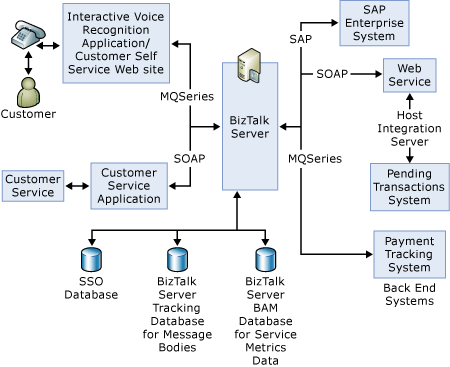
Hiring a BizTalk Developer is essential for organizations that rely on complex system integrations, B2B communication, and enterprise application workflows. BizTalk Server has long been a trusted integration platform for connecting ERP systems, legacy applications, cloud services, and trading partners in a secure and scalable way.
In this article, we’ll explain what a BizTalk Developer does, why enterprises still depend on BizTalk expertise, key technical skills to look for, industries that use BizTalk extensively, and why outsourcing BizTalk Developers is a smart business move.
Who Is a BizTalk Developer?
A BizTalk Developer is an integration specialist who designs, develops, deploys, and maintains solutions using BizTalk Server. Their primary responsibility is to ensure seamless data exchange between disparate systems, both inside and outside the organization.
BizTalk Developers typically work on:
- Enterprise Application Integration (EAI)
- Business-to-Business (B2B) integrations
- ERP, CRM, and legacy system connectivity
- Message transformation and routing
- High-volume, mission-critical integrations
BizTalk Developers often work closely with business analysts, architects, and infrastructure teams to ensure integration flows are reliable and compliant.
Why Companies Hire BizTalk Developers
Despite the rise of newer integration platforms, BizTalk remains deeply embedded in many enterprise ecosystems. Companies hire BizTalk Developers to maintain stability while supporting business growth.
Proven Enterprise Stability
BizTalk is battle-tested in large organizations handling millions of transactions daily.
Complex Integration Handling
BizTalk excels at orchestrating workflows across multiple systems with different data formats.
Strong B2B Capabilities
Built-in support for EDI, AS2, EDIFACT, and X12 standards.
Transaction Reliability
Guaranteed message delivery, tracking, and error handling.
Hybrid Integration Ready
BizTalk integrates well with on-premise systems and cloud services.
Core Skills of a Professional BizTalk Developer
A skilled BizTalk Developer must combine integration logic, XML expertise, and enterprise-level problem solving.
BizTalk Server Architecture
Deep understanding of ports, pipelines, orchestrations, adapters, and host instances.
Message Transformation & Mapping
Strong experience with XML, schemas, maps, and XSLT transformations.
Orchestrations & Business Rules
Designing workflows using orchestrations and Business Rule Engine (BRE).
Adapters & Connectivity
Working with SQL, SAP, Oracle, FTP, HTTP, WCF, and custom adapters.
Error Handling & Monitoring
Exception handling, tracking, BAM, and performance monitoring.
Deployment & Support
Managing MSI deployments, environment configurations, and production support.
Industries That Rely on BizTalk Developers
BizTalk Developers are heavily used in industries where integration reliability is critical.
Enterprise & Corporate IT
Large organizations depend on BizTalk for internal system connectivity.
Banking & Financial Services
Secure, transaction-heavy integrations with strict compliance needs.
Manufacturing & Supply Chain
EDI-based partner communication and ERP integrations.
Healthcare
HL7 and healthcare data integration across systems.
Retail & Logistics
Order processing, inventory synchronization, and partner integrations.
Why Outsource BizTalk Developers?
BizTalk expertise is specialized and often required for maintenance, upgrades, or integration expansion rather than full-time development.
Access to Specialized Talent
BizTalk Developers have niche, enterprise-grade integration experience.
Cost Control
Avoid hiring permanent resources for legacy or maintenance-heavy systems.
Faster Issue Resolution
Experienced developers quickly diagnose and fix production issues.
Flexible Engagement Models
Hire BizTalk Developers for support, migration, or enhancement projects.
Reduced Risk
Experts understand BizTalk’s complexities and production best practices.
Common Use Cases for BizTalk Developers
Organizations hire BizTalk Developers for:
- Enterprise system integration
- B2B and EDI implementations
- Legacy system modernization
- ERP and CRM connectivity
- Hybrid cloud integration
- BizTalk upgrade and support projects
BizTalk remains critical where integration reliability outweighs technology trends.
How to Choose the Right BizTalk Developer
When evaluating a BizTalk Developer, real-world production experience is key.
Look for professionals with:
- Strong BizTalk Server project history
- Experience handling high-volume integrations
- Solid XML, XSLT, and SQL skills
- Knowledge of enterprise integration patterns
- Ability to support and troubleshoot live systems
A strong BizTalk Developer ensures integrations run silently, reliably, and continuously.
Final Thoughts
BizTalk continues to play a vital role in enterprise integration landscapes worldwide. Hiring an experienced BizTalk Developer ensures your critical business systems remain connected, secure, and scalable. Whether you need ongoing support, system enhancements, or complex B2B integrations, BizTalk expertise protects your operational continuity.
If your organization depends on enterprise-grade integrations that must never fail, a BizTalk Developer is an invaluable asset.
Leave a Reply