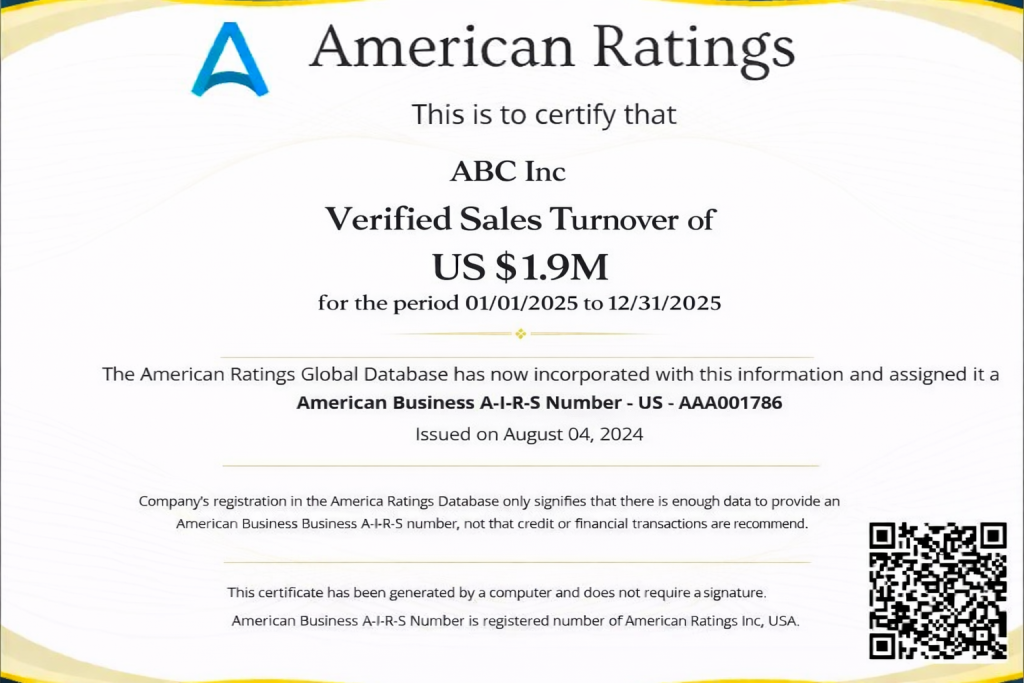
Sales Turnover Certificate: Why It Matters More Than Ever
In today’s business environment, the ability to prove sales turnover has become just as important as generating it. Whether a company is applying for a bank loan, negotiating funding, onboarding with a large vendor, or participating in institutional procurement, decision-makers increasingly demand credible evidence of turnover, not just self-declared figures.
This is where a Sales Turnover Certificate plays a critical role.
A Sales Turnover Certificate is a professionally issued document that validates the basis on which a business reports its sales turnover for a defined period. It serves as an independent trust document that bridges the gap between declared revenue and institutional confidence.
What Is Sales Turnover and Why Is It Scrutinized?
Sales turnover refers to the total value of goods or services sold by a business during a specific time frame. It is one of the most important indicators used by banks, investors, NBFCs, and corporate counterparties to assess:
- Business scale and operational strength
- Repayment capacity and financial stability
- Growth trajectory and sustainability
- Commercial credibility during negotiations
However, sales turnover is also one of the most misrepresented metrics when left unverified. This has led to increased scrutiny, especially in lending, funding, and due-diligence scenarios.
What Is a Turnover Certificate?
A Turnover Certificate is a formal document issued after reviewing supporting financial and transactional records that substantiate reported turnover figures. Unlike casual declarations or unaudited statements, a turnover certificate provides structured validation that institutions can rely on during early-stage evaluation.
In many cases, lenders and investors request a turnover certificate before initiating detailed audits or financial due diligence.
Sales Turnover Certificate vs Audit Report
A common misconception is that audit reports alone are sufficient. While audits are essential for statutory compliance, they are retrospective and often not immediately available when business opportunities arise.
A Sales Turnover Certificate serves a different purpose:
- It is used for pre-screening and early credibility checks
- It helps institutions quickly assess risk
- It accelerates loan approvals, funding discussions, and onboarding decisions
In practice, audits and sales turnover certificates complement each other rather than replace one another.
Why Banks, Investors, and Institutions Ask for Sales Turnover Certificates
Institutions increasingly rely on sales turnover certificates for:
- Business loans and working capital facilities
- Private equity and investor funding assessments
- Vendor onboarding and supply chain approvals
- Government tenders and corporate empanelment
- Credit risk evaluation and internal compliance
A verified sales turnover certificate reduces ambiguity, shortens evaluation cycles, and improves trust between parties.
The Role of Independent Turnover Verification
Independent turnover verification adds a critical layer of credibility. It involves reviewing relevant documentation such as invoices, bank flows, contracts, and transaction records to validate reported sales turnover.
This independent review helps decision-makers distinguish between:
- Actual realized turnover
- Aggressive revenue projections
- Invoices without cash realization
- Selective reporting of financial periods
As a result, businesses that present independently verified sales turnover gain a clear advantage during negotiations.
Why Verified Sales Turnover Is a Competitive Advantage
In competitive funding and lending environments, multiple businesses may apply with similar projections and promises. What differentiates serious applicants is verifiable evidence.
A Sales Turnover Certificate signals that a business understands institutional expectations and is prepared to meet professional standards of transparency. This often results in:
- Faster approvals
- Higher confidence from stakeholders
- Stronger negotiation positioning
- Reduced back-and-forth during evaluations
Conclusion
Sales turnover is no longer just a number—it is a credibility signal. A Sales Turnover Certificate, supported by independent turnover verification, has become an essential trust document for businesses seeking loans, funding, partnerships, or institutional engagement.
Organizations that proactively adopt verified turnover reporting are better positioned to access capital, close deals faster, and build long-term institutional trust.
Leave a Reply